LGBTI RIGHTS: UN SPECIAL PROCEDURES HAVE INCREASED THEIR ENGAGEMENT WITH SOGIESC
Summary
An analysis prepared by ILGA World and ISHR indicates that over the past year thematic and country UN Special Proceduresindependent human rights experts within the UN Human Rights Council with mandates to report and advise on human rights from a thematic or country-specific perspective. They are non-paid and elected for 3-year mandates that can be re-conducted for another three years. Special procedures can undertake country visits, and act on individual cases of reported violations by sending communications to States and others. They also engage in advocacy, raise public awareness, provide advice for technical cooperation, and contribute to the development of international human rights standards.
More mandate holders have increased their engagement with SOGIESCabbreviation standing for sexual orientation and gender identity & expression, and sex characteristics. More topics and tackled different issues and human rights violations suffered by LGBTIacronym for lesbian, gay, bisexual, trans and intersex people. Although this is not the acronym available to describe people of diverse sexual orientations, gender identities and expressions, and sex characteristics, it is the most commonly used in United Nations spaces and advocacy. More persons. This analysis stems from an update of a series of factsheets prepared by ILGA World and ISHR, which list the references and recommendations made regarding LGBTI persons and SOGIESC in communications, thematic reports and country visitsmissions carried out by UN Special Procedure mandate holders to assess the situation of human rights in a specific country. During their missions, they will meet with national and local authorities, national human rights institutions, as well as with NGOs, civil society, and survivors of human rights violations. Findings, conclusions and recommendations of such missions are published in reports to the Human Rights Council. More by mandate holders.
One important development in the update this year was the inclusion of country mandates to the scope of the analysis, covering the 10 country mandates that were active during 2021. This includes the Special Rapporteurs on Belarus, Somalia, Mali, Eritrea, Iran, Cambodia, Central African Republic, Myanmar, Democratic People’s Republic of Korea, and Palestine.
Overall, in relation to LGBTI topics, the Special Procedures sent 52 new communications, issued 8 reports on country visits and published 54 thematic reports.
We welcome the ongoing attention these experts are paying to SOGIESC human rights issues, including particular attention to the situation of LGBTI human rights defenders and discriminatory legislation towards LGBTI persons. For example, several communications concerned the arbitrary arrest and criminalization of LGBTI human rights defenders, and others focused on discriminatory bills and the lack of adequate legislation to protect people with diverse SOGIESC.
We also commend the strong LGBTI focus adopted by the Special Rapporteur on health, as well as the good references to LGBTI people made by the Independent Expert on older persons. We encourage mandate holders to further strengthen their analysis on specific populations within LGBTI communities, such as LBQ women, transadjective/umbrella term to describe a person whose gender identity does not match the sex they were assigned at birth. More or intersexan umbrella term for the spectrum of variations of sex characteristics that naturally occur within the human species. Intersex people are born with variations of sex characteristics (such as genitals, reproductive organs, hormonal and chromosomal patterns) that are more diverse than stereotypical definitions of male or female bodies. Up to 1.7% of the global population are born with such traits; yet, because their bodies are seen as different, intersex children and adults are often stigmatised and subject to harmful practices – including in medical settings - and discriminated against. More persons, BIPOC people with diverse SOGIESC, LGBTI migrants and refugees and LGBTI persons with disabilities.
Find out more about the trends in 2021 below! You can find the updated factsheets here.
Which experts include LGBTI issues most regularly?
The mandates that made the most regular references to SOGIESC issues were:
- the Independent Expert on violence and discriminationunequal or unfair treatment which can be based on a range of grounds - such as age, ethnic background, disability, and diverse sexual orientations, gender identities and expressions or sex characteristics, amongst others. More on the basis of SOGIabbreviation standing for sexual orientation and gender identity More (34 items: 2 SOGIESC-inclusive thematic reports, 1 country report and 31 communications on LGBTI relevant topics);
- the Special Rapporteur on freedom of expression (31 items);
- the Special Rapporteur on human rights defenders (30 items);
- the Special Rapporteur on freedom of peaceful assembly and of association (26 items);
- the Working Group on arbitrary detention (22 items)
- the Working Group on discrimination against women and girls (20 items);
- the Special Rapporteur on torture (20 items);
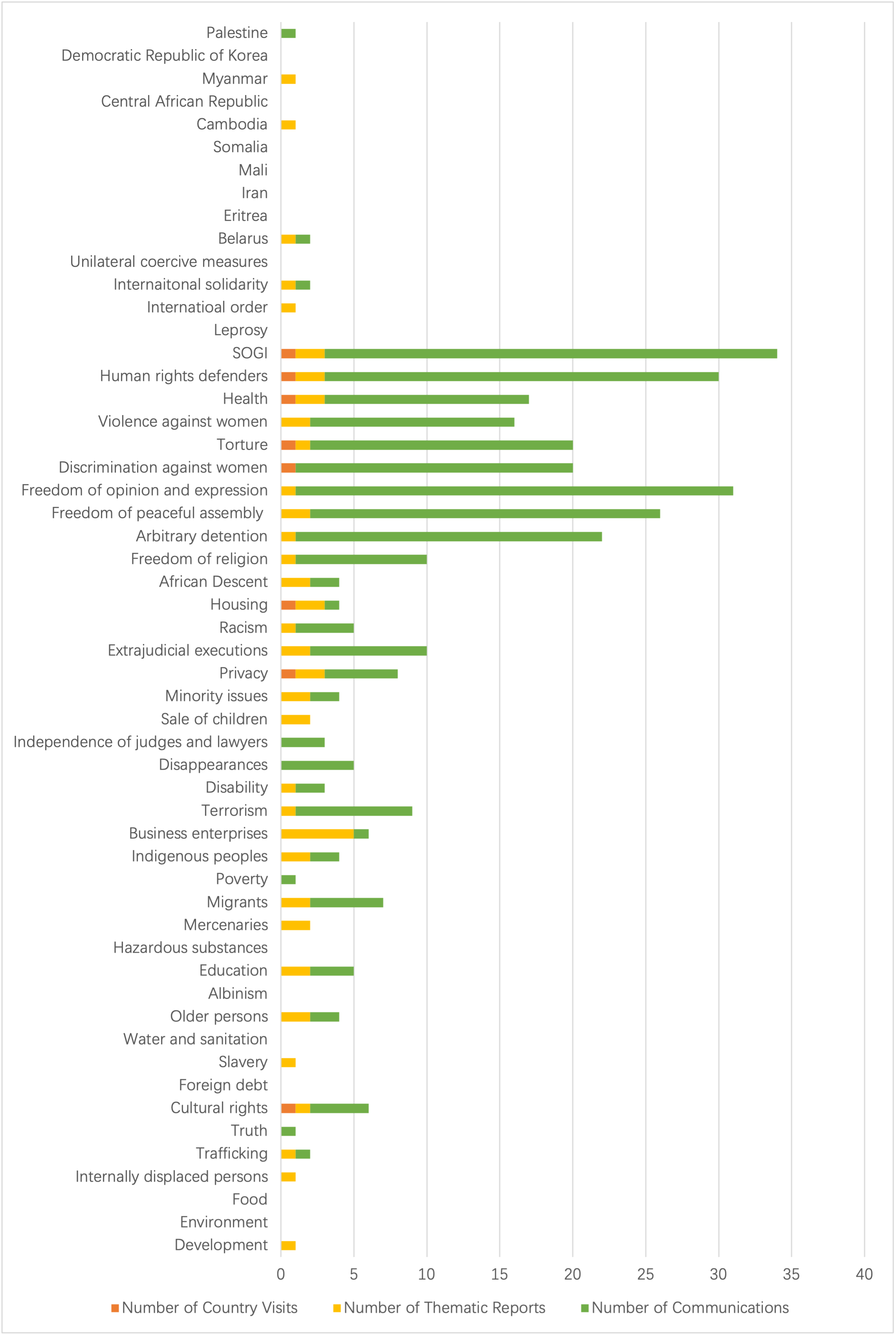
2021 SOGIESC thematic reports, country visits and communications by mandates
Communications
52 new communications focused on SOGIESC – letters concerning allegations of human rights violations – were sent by thematic and country mandates for the period from 21 November 2020 to 31 December 2021.
31 communications were made with the Independent Expert on SOGI. In addition, other 21 communications made by the remaining mandates that contained LGBTI references were considered in this analysis, even if they were not co-issued with the IE on SOGI. Therefore, the other top mandates that included LGBTI references in their communications were the Special Rapporteur on freedom of expression (30 communications), the Special Rapporteur on human rights defenders (27 communications), and the Special Rapporteur on peaceful assembly and association (24 communications). In a welcome advance, the Special Rapporteur on truth and the Special rapporteur on Belarus made their first communication covering SOGI.
Communications covering SOGIESC issues were sent to 36 states from all UN geographical clusters: Afghanistan, Algeria, Belarus, Brazil, Bulgaria, Canada, China, Colombia, Egypt, Eritrea, France, Ghana, Guatemala, Honduras, Hungary, Israel, Japan, Kazakhstan, Kyrgyzstan, Malaysia, Mexico, Myanmar, Nicaragua, Pakistan, Peru, Poland, Russian Federation, Saudi Arabia, Sri Lanka, Thailand, Tunisia, Turkey, Uganda, United States of America, Uzbekistan, Venezuela.
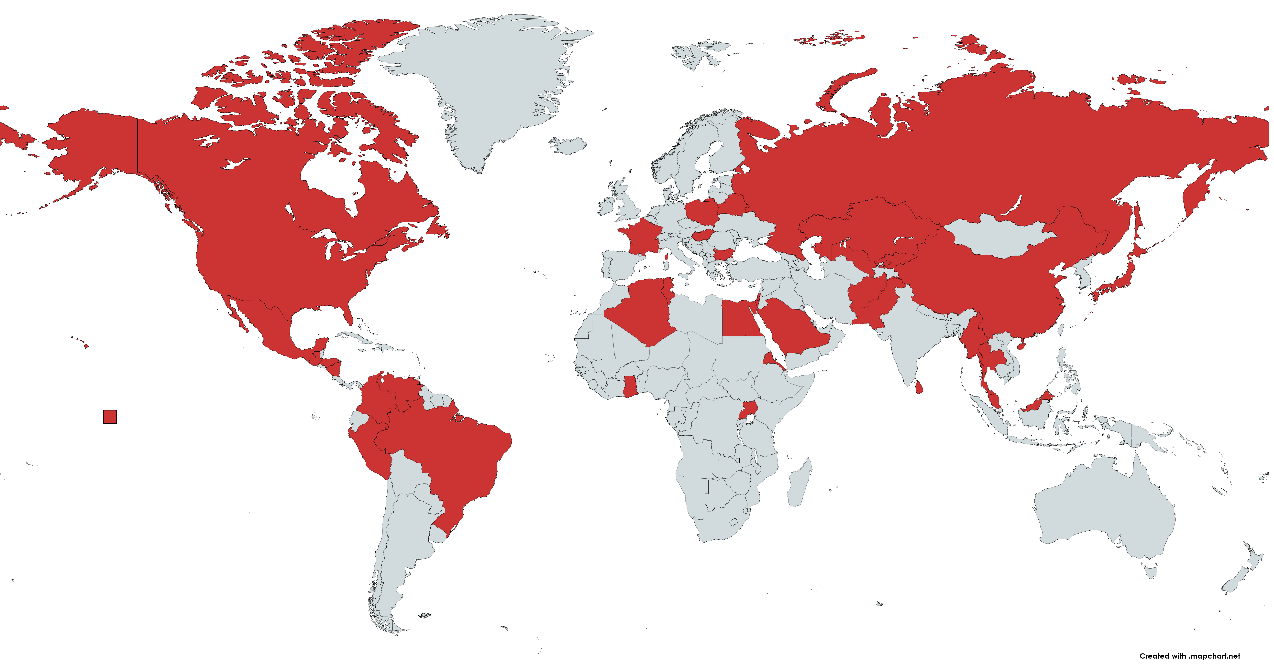
Countries that received communications
Country visits
Due to the Covid-19 pandemic, the number of country visits has declined this year. This fact also impacted the number of SOGIESC references in country visits reports, which encompassed 8 countries in all five UN geographical clusters.
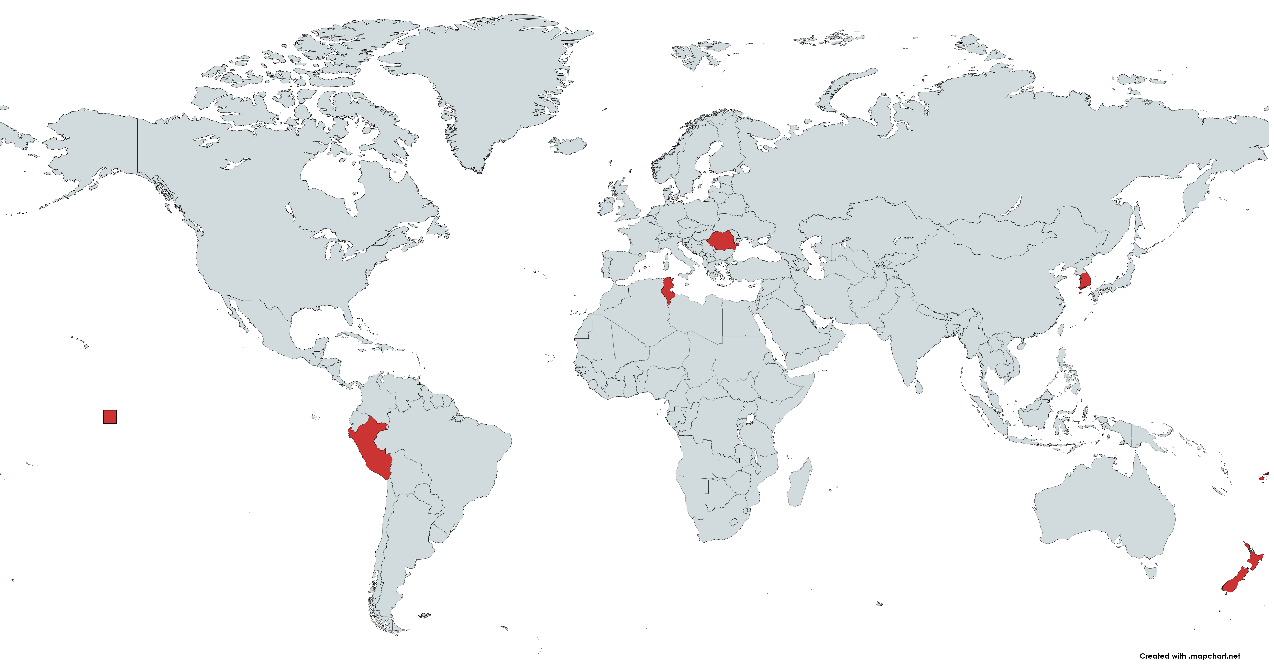
Country visit reports published
The countries include: Fiji, Maldives, New Zealand, Peru, Romania, South Korea, Tunisia and Tuvalu.
Despite the decline on country visits this year, an important advancement to highlight is that the Special Rapporteur on the right to privacy presented its first SOGIESC-inclusive country report in 2021.
Thematic reports
Special Procedures also included SOGIESC elements in their thematic reports to the Human Rights Councilan inter-governmental body within the United Nations which has the responsibility to promote and protect human rights. It is comprised of 47 member States, each elected to 3-year terms by the 193 member States of the United Nations. More and General Assemblythe main deliberative and policy-making organ of the United Nations which makes decisions on international issues such as development and peace and security. All 193 member States are represented, and each has one vote. More. In 2021, 54 reports (slightly less that 50% of all thematic reports) made references to SOGIESC and LGBTI, with 15 of these reports – set out in the table below – including good or strong references to LGBTI populations.
2021 Thematic reports with good or strong SOGIESC references
| Mandate | Report Topic | References |
| WORKING GROUP OF EXPERTS ON PEOPLE OF AFRICAN DESCENT | The Urgency of Now: Systemic Racism and the opportunities of 2021 August 2021 (76th Session GA) |
Good references to LGBTQI, homophobiafear, unreasonable anger, intolerance or/and hatred directed towards people attracted to others of the same gender. More, and gender identityrefers to a person’s deeply felt internal and individual experience of gender, which may or may not correspond with the sex assigned at birth. More and gender expressionrefers to how a person presents their gender through physical appearance – including dress, hairstyles, accessories, cosmetics – and mannerisms, speech, behavioural patterns, names and personal references. More (Covid-19 movement restrictions on the base of genderrefers to a social construct which places cultural and social expectations on individuals based on their assigned sex. More affecting transgender people, right to health and homophobia, and attacks against LGBTQI human rights defenders of African descent) Paras. 37, 64, 69. |
| SPECIAL RAPPORTEUR ON THE PROMOTION AND PROTECTION OF THE RIGHT TO FREEDOM OF OPINION AND EXPRESSION | Artistic Freedom of Expression July 2020 (44th Session (HRC) |
Good reference to LGBT, sexual minorities (suppression of LGBTQ activists, artists, and artistic events and expression) Para. 1, 28, 32-35. |
| WORKING GROUP OF EXPERTS ON ARBITRARY DETENTION | Deprivation of liberty of human rights defenders, forcible transfers of individuals and prohibition of arbitrary detention, and the Declaration against Arbitrary Detention in State-to-State relations.
August 2021 (48th Session HRC) |
Good references to LGBTI.
(In the context of significant risk of detention for LGBTIQ+ defenders; Experience of liberty; discriminatory grounds) Paras. 6, 12, 14, 39, 40, 41, 42, 43, 44, 45, 46, 47, 49 of Annex (Deliberation No. 12 on women deprived of their liberty) |
| WORKING GROUP ON THE ISSUE OF HUMAN RIGHTS AND TRANSNATIONAL CORPORATIONS AND OTHER BUSINESS ENTERPRISES | Fifth Regional Forum for Latin America and the Caribbean on Business and Human Rights
June 2021 (47th Session HRC) |
Good references to LGBTI
(Special attention to LGBTI people in due diligence processes; considering the effects of the pandemic on LGBTI people; gender mainstreaming; Combating discrimination; differential human rights impact; mainstreaming the gender perspective in business) Paras. 4, 45, 96, 98, 99, 100, 101, 106d, 108e, 108k |
| SPECIAL RAPPORTEUR IN THE FIELD OF CULTURAL RIGHTS | COVID-19, culture and cultural rights February 2021 (46th Session HRC) | Shrinking civic space, spreading fake information, online harassment, but also opportunity for increased connections in virtual spaces (paras. 27, 28, 31, 48, 79l) |
| SPECIAL RAPPORTEUR ON THE PROMOTION AND PROTECTION OF THE RIGHT TO FREEDOM OF OPINION AND EXPRESSION | Gender justice and freedom of opinion and expression. July 2021 (76th Session GA) | Suppression of SOGI expression, hate speechany kind of communication in speech, writing or behaviour that attacks or uses pejorative or discriminatory language with reference to a person or a group on the basis of who they are – including on the grounds of their gender, sexual orientation, gender identity and expression, or sex characteristics amongst others. More, laws prohibiting “LGBT propaganda” (paras. 8, 11-12, 17-19, 23-24, 27-31, 34, 37, 41, 55, 83, 90, 112f, 115, 121d) |
| SPECIAL RAPPORTEUR ON THE RIGHT OF EVERYONE TO THE ENJOYMENT OF THE HIGHEST ATTAINABLE STANDARD OF PHYSICAL AND MENTAL HEALTH | Sexual and reproductive health rights: challenges and opportunities during COVID-19; July 2021 (76th Session GA) | Strong references to SOGIESC.
(Links State-sponsored homophobia, heteronormativitya set of beliefs and practices that consider heterosexuality as the norm when it comes to sexual orientations. It also implies that people’s gender, sex and sex characteristics are by nature and should always be aligned, and therefore heterosexuality is the only conceivable sexuality. More, legal restrictions on consensual same-sex acts to colonialism; underscores specific sexual and reproductive health needs of individuals with diverse gender identities; call to end involuntary sterilization, medical procedures related to transitionrefers to a series of steps people may take to live in the gender they identify with. A person’s transition can be social and/or medical. Steps may include: coming out to family, friends and colleagues; dressing and acting according to one’s gender; changing one’s name and/or sex/gender on legal documents; medical treatments - including hormone therapies and possibly one or more types of surgery. More, including surgeries, hormonal therapies, medical or psychosocial appraisals or treatments; access to gender affirming treatment for trans and gender-diverse children and adolescents) Paras. 1, 4, 6, 9, 10, 11, 19, 20, 21, 45, 46, 47, 48, 54, 57, 82, 87 |
| Strategic priorities of work June 2021 (47th Session HRC) |
Strong references to SOGIESC.
(Vulnerability of LBT women to violence and homophobic rape; call to end the use of ’corrective rape’ term; disproportionate effects of intersectional discrimination in the context of sexual and reproductive health on LGBTI people; abuse of LGBT people by untrained health-care workers, including public humiliation, verbal abuse, psychiatric evaluations, coerced sterilization, State-sponsored forcible anal examinations for the prosecution of suspected homosexual activities, invasive virginity examinations, hormone therapy and genital normalizing surgeries) Paras. 15, 16, 20, 23(a), 45, 54, 55, 56, 57, 58, 59, 60, 64, 66, 73, 75, 77, 90, 103. |
|
| SPECIAL RAPPORTEUR ON THE SITUATION OF HUMAN RIGHTS DEFENDERS | Final warning: death threats and killings of human rights defenders December 2020 (46th Session HRC) | Gendered threats, need support for defenders from vulnerable groups (paras. 41, 57, 65, 67, 69, 101, 115d) |
| SPECIAL RAPPORTEUR ON MINORITY ISSUES | Minorities, equal participation, social and economic development and the 2030 Agenda for Sustainable Development. July 2021 (GA76) | Good references to LGBT (paras. 43, 45, 78, 79); |
| Hate speech, social media and minorities. March 2021 (HRC46) | Good SOGIESC references (paras. 60g, 60h, 87, 88, 89) | |
| INDEPENDENT EXPERT ON THE ENJOYMENT OF ALL HUMAN RIGHTS BY OLDER PERSONS | The human rights of older women: the intersection between ageing and gender (GA76) | Good reference to SOGIESC, especially on the situation of older LBTI women (paras. 9, 15, 42, 48, 76, 82) |
| SPECIAL RAPPORTEUR ON THE RIGHT TO PRIVACY | Artificial intelligence and privacy, and children’s privacy January 2021 (46th Session HRC) |
Good references to SOGIESC.
(Risks of violence, sexual abuse, cyberbullying in digital life for LGBTI young people; infringement of bodily integrity autonomy rights of children with diverse gender identities, sexual orientationrefers to a person’s capacity for profound emotional, affectional and sexual attraction to - and intimate and sexual relations with - individuals of a different gender or the same gender or more than one gender. More, and sex characteristicsa term that refers to physical features relating to sex - including genitalia and other sexual and reproductive anatomy, chromosomes, hormones, and secondary physical features emerging from puberty. More, including mandatory surgeries for legal gender recognitionlaws, administrative procedures or processes by which a person can change their sex/gender marker and names on official identity documents. More; the role of comprehensive sexuality education in advancement of the right to privacy and wellbeing of LGBTI young people) Paras. 89, 98(c), 99(b), 99(d), 100, 103. |
| SPECIAL RAPPORTEUR ON THE SALE AND SEXUAL EXPLOITATION OF CHILDREN | Thematic study on the gender dimension of the sexual exploitation of children and the importance of integrating a child-centred and gender-inclusive approach to combating and eradicating the scourge (GA76) | Vulnerability of young LGBTI persons to violence and abuse and the lack of support mechanisms for them, overlooking of transgender and non-binarya person who does not identify exclusively as a man or a woman. While many also identify as trans, not all non-binary people do. Non-binary can also be used as an umbrella term encompassing identities such as agender, bigender, genderqueer or gender-fluid. More children (paras. 2-4, 7, 10-13, 16, 18, 20-27, 32-37, 41, 44, 46, 52-54, 60, 67-68, 70-74, 76, 81-82, 84) |
| INDEPENDENT EXPERT
ON PROTECTION AGAINST VIOLENCE AND DISCRIMINATION BASED ON SEXUAL ORIENTATION AND GENDER IDENTITY |
Gender Theory (the law of inclusion) |
Explores the notion of gender and the existent theory and literature on the subject, including the current state of international law in relation to gender and gender identity and expression and its connection with the struggle against violence and discrimination; analyses the construct of the gender binary structural system and its consequences, such as the human rights violations inflicted on LGBTI persons, as well as the importance of ensuring legal gender recognition for trans communities and intersex persons bodily autonomy. |
| Gender part II (practices of exclusion) July 2021 (76th Session GA) |
Analyses backlash against the incorporation of gender frameworks into international human rights lawa legal system laying down obligations which States are bound to respect. By becoming parties to international treaties, States assume obligations and duties under international law to respect, protect and fulfil human rights – including by putting into place domestic measures and legislation. Where domestic legal proceedings fail to address human rights abuses, mechanisms and procedures for individual complaints or communications are available at the regional and international levels to help ensure that international human rights standards are respected. More, the risks that the backlash poses for the rights of women (including lesbianadjective/noun to describe a woman whose enduring physical, romantic, and/or emotional attraction is to other women. Women and non-binary people may use this term to describe themselves. More, bisexualadjective used to describe a person who has the capacity to form enduring physical, romantic, and/ or emotional attractions to those of the same gender or to those of other genders. More and trans women) and for efforts to combat violence and discrimination based on sexual orientation and gender identity; and its connection with efforts to undermine multilateralism; discusses the notion of “gender ideology” and the rise and financing of anti-gender narratives. |
